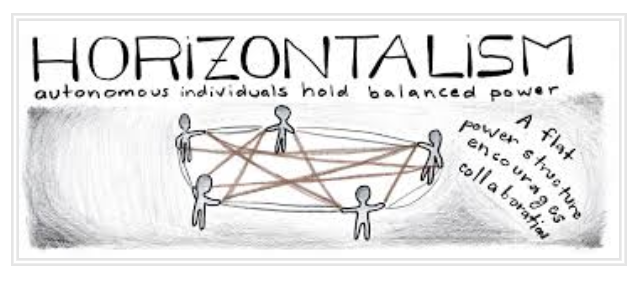
Horizontal Governance: Democratizing Institutions, Organizing Without Hierarchy
Step #1 Handout (5 minutes)
Power always exists.
Participation requires structure.
Human flourishing increases when people have agency.
our questions are:
How can groups empower people rather than merely make them obedient? How can groups help people become more capable, more connected, and more free? How can groupss maximize human agency, participation, autonomy, and flourishing while minimizing domination?
List books with links (book list is below)
Mini-Lecture (10 minutes)
introduce ideas from books, talk about successes: Zapatistas, Argentine neighborhood assemblies, Occupy Wall Street, Quaker meetings, Democratic confederalism in Rojava
First Exercise (10 minutes) break into small groups
instructor goes first
#1: "Think of the most frustrating organization you've ever belonged to."
#2: "Think of the most empowering group you've ever belonged to. What made it empowering? Who held power? How were decisions made?”
Second Exercise (instructor goes first)
instructor presents following structure (Formal Power - Board, Executive Director, Minister, Principal, Manager; Informal Power - Long-time members, Charismatic personalities, Major donors, Experts; Ignored Voices - New members, Volunteers, Youth, Marginalized groups)
#1 - Students individually Draw Diagrams of Hierarchies they’ve known
#2 - Students draw Diagrams of Horizontal or circular groups they’d like to be in
#3 - Redesign a group you belong to. Explain - What power structure exists now? How could it become more horizontal? What safeguards would prevent hidden power?
Third Exercise - Small-Group Problem Solving
Scenario A — An activist group has 200 members, but it seems like only 10 people regularly make decisions. How could power be redistributed?
Scenario B — A nonprofit has a charismatic but bossy founder. People are afraid to disagree with them. How would a horizontal structure solve this?
Scenario C —A student club is inactive because nobody wants to lead. How can the club get members to participate?
Fourth Exercise - Horizontal Decision-Making with a Facilitator
(Instructor describes the Zapatista model. Everybody in each group gets 3 minutes as facilitator)
Each group’s problem: "Your group received $100,000 for community improvement. How should it be spent?"
Ask: What worked? What was frustrating? Did anyone dominate? Did anyone stay silent? What would improve the process?
—-
BOOK/Essay LIST with links
Horizontalism: Voices of Popular Power in Argentina - Marina Sitrin https://files.libcom.org/files/Sitrin%20(Ed.)%20-%20Horizontalism%20-%20Voices%20of%20Popular%20Power%20in%20Argentina.pdf
The Democracy Project - David Graeber https://ia600706.us.archive.org/21/items/politicsDEEPWEB/Democracy%20Project_%20A%20History%2C%20a%20Crisis%2C%20a%20Movement%2C%20The%20-%20David%20Graeber%20%281%29.pdf
The Empowerment Manual - Starhawk https://sustainabilitypopulareducation.wordpress.com/wp-content/uploads/2014/05/the-empowerment-manual_nodrm.pdf
Anarchy Alive! - Uri Gordon https://files.libcom.org/files/anarchy_alive.pdf
Change the World Without Taking Power - John Holloway https://platypus1917.org/wp-content/uploads/readings/Holloway_Change_the_World.pdf
Our Word Is Our Weapon - Subcommandante Marcos https://theanarchistlibrary.org/library/subcomandante-marcos-our-word-is-our-weapon
The Tyranny of Structurelessness - Jo Freeman https://www.jofreeman.com/joreen/tyranny.htm
The Ecology of Freedom - Murray Bookchin https://theanarchistlibrary.org/library/murray-bookchin-the-ecology-of-freedom
Teaching to Transgress - bell hooks https://faculty.bard.edu/hhaggard/teaching/sci127Sp20/notes/hooksTeachingToTransgress1.pdf
Quakerism, Anarchy & Everything in Between https://theanarchistlibrary.org/library/locusts-and-wild-honey-quakerism-anarchy-and-everything-in-between
Anarchism and Taoism - Josh https://theanarchistlibrary.org/library/josh-anarchism-and-taoism
Pedagogy of the Oppressed - Paolo Freire https://fsi-ebcao.princeton.edu/sites/g/files/toruqf1411/files/media/freire.pdf