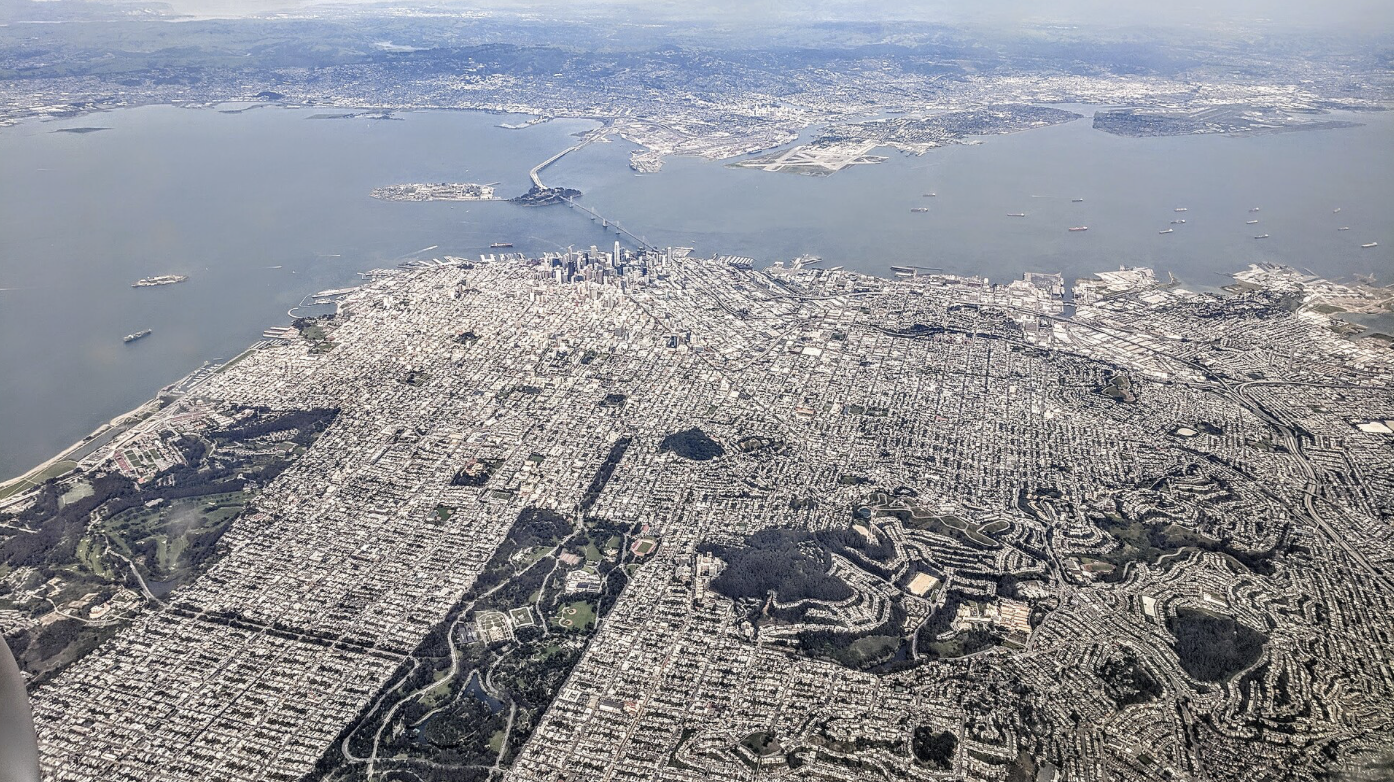
Manifesto for the San Francisco Bioregion
A proposal for ecological restoration and social equality — organized through watersheds
In The Ohlone Way, the San Francisco Peninsula—before the arrival of colonialism and capitalism—is described as a landscape of remarkable abundance: salmon-bearing streams, freshwater lakes, coastal dunes, tidal marshes, oak groves, grasslands, and thriving human communities. The San Francisco Bioregion once demonstrated that human communities could exist within a flourishing ecological system. Remembering this inspires us to build a new egalitarian future.
Today, San Francisco contains enormous suffering caused by brutal inequality and entrenched hierarchies. Life expectancy varies dramatically between neighborhoods due to persistent injustice. Thousands of people remain unhoused while luxury apartments stand vacant. Non-human species are stripped of habitat and threatened with extinction. Two hundred years ago Indigenous villages in this region treated land, water, and food as common gifts of nature, but today every basic necessity is available only to those who can pay ever-increasing prices. The laws governing our communities are often formulated by distant bureaucracies and corporate interests far removed from everyday life, while the city's creeks remain buried beneath pavement and its wildlife struggles to survive in fragmented habitats.
Green democracy must begin here, in the San Francisco Bioregion. Political communities should be organized within ecological geography. Rather than treating watersheds as invisible infrastructure, we believe they should become the living foundation of democratic society.
This manifesto proposes the creation of a federation of watershed democracies organized around direct participation, economic equality, ecological restoration, and mutual aid.
ECOLOGICAL GOALS
Watersheds are geographical systems that sustain networks of life. The San Francisco Bioregion is a federation of watersheds linked by shared ecology, groundwater, wetlands, forests, shoreline, and the waters of San Francisco Bay and the Pacific Ocean. We want our human communities to exist in collaboration with these living systems. The health of every watershed should become one of the principal measures of our social success.
To accomplish this, we propose the following:
Restore Every Creek and Stream - Most of San Francisco's natural waterways have disappeared beneath streets and buildings. Streams that once nourished wetlands and wildlife now flow unseen through culverts and storm drains. We seek to daylight Islais Creek, Mission Creek, Lobos Creek, Yosemite Creek, and other buried waterways wherever restoration is possible. We also seek to restore the watersheds surrounding Lake Merced, Mountain Lake, and remaining seasonal creeks. Our waterways should once again become ecological corridors rather than underground plumbing. Restored creeks will provide habitat for birds, amphibians, insects, fish, and native plants while reducing flooding, improving water quality, cooling neighborhoods, and reconnecting residents with the natural history of their city.
Reforestation - We will plant millions of trees throughout the San Francisco Bioregion, prioritizing Coast Live Oak, California Bay Laurel, California Buckeye, Alder, Willow, Cottonwood, California Sycamore, and other native species suited to local habitats. Coastal scrub, native shrubs, flowering plants, and dune vegetation will also be extensively restored.
Urban forests reduce heat, improve air quality, capture carbon, stabilize hillsides, support biodiversity, absorb stormwater, and make neighborhoods healthier places to live.
Every school should have an orchard.
Every park should contain edible landscapes.
Every neighborhood should include food forests.
Every major street should be shaded by native trees.
Pollinator corridors should connect parks, gardens, rooftops, and restored creek systems throughout the city.
Rather than isolated patches of green, San Francisco should become an interconnected urban forest.
Rewild Habitat Corridors
Wildlife must once again move safely throughout our landscapes.
We seek to reconnect habitats linking the Presidio, Golden Gate Park, Twin Peaks, Mount Davidson, Glen Canyon, McLaren Park, Lake Merced, Fort Funston, and the restored southeastern shoreline. These connected habitats will allow deer, coyote, gray fox, raccoon, river otter, skunk, owl, hawk, falcon, shorebirds, waterfowl, butterflies, native bees, and countless other species to flourish.
Healthy ecosystems require movement.
Creeks should connect hills to wetlands.
Wetlands should connect to the Bay.
The Bay should once again support thriving salmon, steelhead trout, herring, seals, seabirds, and migratory waterfowl.
Human prosperity depends upon the prosperity of every other living species.
Restore the Shoreline
For more than a century, much of San Francisco's shoreline has been filled, armored with seawalls, industrialized, or separated from natural tidal processes. Wetlands that once supported enormous biodiversity have largely disappeared.
Our goal is to restore tidal marshes, mudflats, beaches, estuaries, eelgrass beds, and shoreline habitat wherever possible. Native oysters, herring, salmon, shorebirds, seals, and migratory waterfowl all benefit from healthy coastal ecosystems.
Ocean Beach should once again support thriving native dune systems. The southeastern waterfront should include extensive restored wetlands capable of filtering pollution, absorbing storm surges, storing carbon, and providing habitat for countless species.
Healthy shorelines protect both people and wildlife.
By daylighting creeks, improving water quality, restoring wetlands, removing unnecessary barriers, and protecting spawning habitat, salmon and steelhead can once again migrate through portions of the San Francisco Bioregion.
The Bay should no longer be viewed as the edge of the city.
The Bay is the heart of our bioregion.
Greenway Network
People should be able to walk or bicycle throughout the San Francisco Bioregion using an interconnected network of greenways following restored creeks, parks, food forests, urban gardens, wetlands, and shoreline trails.
Safe bicycle highways and pedestrian corridors should connect every neighborhood without dependence upon automobiles.
Greenways should also function as wildlife corridors, rainwater infiltration systems, pollinator pathways, outdoor classrooms, and places for recreation and community gathering.
Transportation infrastructure should heal ecosystems rather than fragment them.
Replace Lawns with Living Landscapes
Lawns consume enormous quantities of water, fertilizer, labor, and energy while producing almost no food or wildlife habitat.
We propose replacing ornamental lawns with native gardens, orchards, vegetable gardens, food forests, pollinator habitat, medicinal plants, and community gathering spaces.
Every schoolyard, church, apartment complex, office campus, and public building should become part of San Francisco's ecological restoration.
Beauty and productivity should exist together.
Every neighborhood should produce food.
Every neighborhood should support biodiversity.
In our San Francisco Bioregion every creek will run clean, every neighborhood will be shaded by trees, every resident will live within walking distance of fresh food, parks, and restored habitat, and wildlife will once again move throughout the city. Salmon and steelhead may once again return to restored waterways. Native birds will flourish. Pollinators will thrive.
Human flourishing and ecological flourishing will be recognized as inseparable goals.
FOOD SOVEREIGNTY
Our bioregion should produce a significant portion of its own food.
Community farms, rooftop gardens, edible streetscapes, food forests, neighborhood orchards, cooperative greenhouses, and vertical agriculture should become normal features of urban life.
Vacant lots, rooftops, school grounds, underused parking areas, public land, and former lawns should become productive landscapes.
Every resident should live within walking distance of fresh fruits, vegetables, herbs, and community food production.
Food should not travel thousands of miles before reaching our tables.
A resilient city feeds itself.
Food is not merely a commodity.
Food is a human right and a common good.
SOLAR FOR ALL
San Francisco enjoys abundant wind and sunlight.
We seek to establish rooftop solar on residential, commercial, industrial, and public buildings throughout the city.
Parking lots should be covered by solar canopies.
Public buildings should become renewable energy producers rather than consumers.
Neighborhood microgrids, community battery storage, district heating systems, and community-owned energy cooperatives should replace centralized fossil fuel dependence.
Public transportation should be fully electrified.
Walking, cycling, and transit should become the preferred forms of transportation.
Our long-term objective is to reduce private automobile traffic by approximately ninety percent while creating cleaner, quieter, safer neighborhoods.
Renewable energy should belong to communities rather than distant corporations.
GREEN ARCHITECTURE
Buildings should become living components of ecological systems rather than isolated structures.
Green roofs, green walls, rooftop gardens, native vegetation, edible landscapes, and rainwater harvesting should become standard features throughout the city.
Greywater recycling should dramatically reduce freshwater consumption.
Permeable pavement should replace unnecessary concrete wherever practical, allowing rainwater to recharge soils instead of overwhelming storm drains.
New construction should prioritize passive solar design, natural ventilation, recycled materials, and energy efficiency.
Many streets should become pedestrian plazas filled with trees, gardens, markets, cafés, and public gathering spaces.
Dense housing and mixed-use neighborhoods can coexist beautifully with abundant green space when cities are thoughtfully designed.
Architecture should restore nature rather than replace it.
TRUE DEMOCRACY
We seek to end hierarchy in all its forms—economic, political, social, racial, cultural, and ecological.
At the most local level we envision Neighborhood Assemblies composed of approximately 5,000 to 10,000 residents.
These assemblies become the primary governing institutions of society.
Residents meet regularly to deliberate and decide questions involving housing, transportation, public space, education, ecological restoration, neighborhood planning, local budgets, and community life.
There are no professional political representatives making decisions on behalf of others.
People govern themselves directly.
No issue is delegated upward unless coordination beyond the neighborhood becomes genuinely necessary.
Above the Neighborhood Assemblies are the Ward Councils, each representing approximately 100,000 people through a confederation of ten to twenty neighborhood assemblies.
Ward Councils coordinate projects that extend beyond individual neighborhoods, including education, major transportation systems, hospitals, watershed restoration, regional parks, public utilities, emergency preparedness, and shared infrastructure.
Delegates are sent by the Neighborhood Assemblies. They are not independent politicians or permanent office holders. They carry the clearly expressed decisions of their assemblies and remain accountable to those who selected them.
Delegates are recallable at any time, serve short terms, and rotate regularly.
They do not govern the people.
They communicate the people's decisions.
Above the Ward Councils stands the San Francisco Bioregional Council, composed of delegates from every Ward Council.
Its purpose is coordination rather than centralized authority.
Its responsibilities include restoring major watersheds, coordinating renewable energy systems, managing shoreline restoration, protecting biodiversity, planning regional transportation, preparing for earthquakes and climate emergencies, and maintaining cooperation between neighborhoods.
Authority remains rooted in the Neighborhood Assemblies.
Decision-making rises upward only when coordination across the entire bioregion becomes necessary.
Government exists to facilitate cooperation rather than exercise domination.
CREATING THE COMMONS
Land reform is essential to the future of the San Francisco Bioregion.
Land should gradually transition from speculative private ownership toward systems of common stewardship.
Land is not a commodity.
Land is the ecological foundation of life itself.
Housing, workplaces, farms, forests, watersheds, and shorelines should increasingly be managed as shared commons that exist to benefit everyone.
Factories, businesses, and major workplaces should increasingly become worker cooperatives governed democratically by those who work within them.
Production should be organized around social need rather than private accumulation.
Housing should become a guaranteed social right.
No one should profit simply because they own the place where another person must live.
The immense wealth created by our communities should circulate throughout those communities rather than concentrating into the hands of a small economic elite.
We envision a society without homelessness, without billionaires, without landlord domination, and without inherited economic privilege.
The purpose of the economy is not endless growth.
Its purpose is human well-being within ecological limits.
GIFT ECONOMY TRANSITION
Our long-term goal is to move gradually from exchange toward gifting.
From buying toward sharing.
From ownership toward stewardship.
From competition toward cooperation.
The Gift Economy we envision is neither barter nor hidden accounting.
It is a society organized around generosity, reciprocity, mutual aid, and trust.
People contribute according to their abilities and receive according to their needs.
Libraries become larger.
Tool libraries become common.
Community kitchens flourish.
Repair cafés replace disposable consumption.
Free stores become neighborhood institutions.
Knowledge, education, culture, software, seeds, and practical skills circulate freely.
As abundance grows through cooperation, dependence upon money steadily declines.
Human relationships become more valuable than financial transactions.
Our greatest wealth becomes our capacity to care for one another.
UPCYCLING
Modern industrial society discards enormous quantities of useful materials while consuming vast amounts of energy to manufacture replacements.
We seek to establish neighborhood workshops dedicated to repair, refurbishment, remanufacturing, and creative reuse.
Residents will learn carpentry, sewing, electronics repair, appliance maintenance, bicycle mechanics, woodworking, metalworking, and other practical skills.
Repair extends the life of products, reduces waste, conserves resources, and strengthens community self-reliance.
Instead of throwing objects away, we ask: Can it be repaired? Can it be improved? Can it become something entirely new?
The circular economy begins in every neighborhood workshop.
JUSTICE
Justice should restore communities rather than merely punish individuals.
Today's criminal justice systems often separate people from their communities while failing to repair the harms that have occurred.
Our goal is restorative justice.
When conflicts arise, we seek mediation, accountability, restitution, reconciliation whenever possible, and the rebuilding of healthy relationships.
Community mediation councils, trained facilitators, mental health professionals, restorative justice circles, and neighborhood assemblies should become primary institutions for resolving conflict.
Prisons should become increasingly unnecessary as inequality declines, communities strengthen, and the causes of violence are addressed.
Justice is measured not by the severity of punishment but by the restoration of trust, safety, and human dignity.
OUR POLITICAL STRATEGY
The transformation we envision cannot be imposed from above.
It must emerge through democratic participation.
Every community garden, every worker cooperative, every neighborhood assembly, every restored creek, every solar cooperative, every food forest, every repair café, and every mutual aid network becomes part of the new society already growing inside the old one.
As these institutions demonstrate their effectiveness, they gradually replace the centralized institutions that no longer serve the public good.
Representative democracy gradually gives way to participatory democracy.
Corporate ownership gradually gives way to cooperative ownership.
Private accumulation gradually gives way to common stewardship.
Competition gradually gives way to mutual aid.
Hierarchical power steadily gives way to democratic confederation.
Revolution is understood not as a single dramatic event but as the patient construction of better institutions.
Our strategy is to build the future until it becomes stronger than the past.
SUMMARY
We envision a San Francisco where buried creeks once again flow beneath open skies, where restored wetlands protect the shoreline, and where native forests, gardens, and wildlife flourish alongside vibrant human communities.
Wildlife corridors connect the Presidio, Golden Gate Park, Twin Peaks, Glen Canyon, Mount Davidson, McLaren Park, Lake Merced, Ocean Beach, and the southeastern shoreline. Restored streams feed wetlands rather than storm drains. Native dunes once again overlook the Pacific Ocean. Pollinators fill neighborhood gardens. Salmon and steelhead return to restored waterways where conditions allow.
Every neighborhood produces food.
Every resident enjoys access to parks, gardens, clean water, renewable energy, and public gathering places.
No one is homeless.
No one possesses enormous wealth while others lack life's necessities.
Neighborhood assemblies meet beneath restored groves of native trees.
Governance becomes cooperation among equals.
The economy becomes organized around sharing rather than accumulation.
The commons become larger every year.
Human prosperity and ecological restoration become one and the same project.
The San Francisco Bioregion becomes not merely a city but a living community where democracy, ecology, beauty, and mutual aid reinforce one another.
This is not a utopia beyond history.
It is a direction.
A society that continuously restores both the Earth and the relationships among the people who inhabit it.
REFERENCES
This manifesto draws inspiration from the traditions of anarchist geography, social ecology, bioregionalism, ecological restoration, and democratic confederalism. It is intended not as a rigid blueprint but as an invitation to imagine how freedom, equality, and ecological flourishing can reinforce one another within a living bioregion.
Peter Kropotkin — mutual aid, the commons, decentralized federation, gift economy, voluntary cooperation
Élisée Reclus — anarchist geography, bioregionalism, ecological restoration, humanity as part of nature
Murray Bookchin — social ecology, neighborhood assemblies, democratic confederalism
Starhawk — participatory democracy, urban ecological restoration, consensus, community resilience
Ernest Callenbach — ecological cities, sustainable transportation, appropriate technology
bell hooks — dismantling domination, love as an ethic of liberation, feminist democracy, education for freedom
B. R. Ambedkar — social equality, constitutional democracy, liberation from inherited hierarchy
Rojava — democratic confederalism and local assemblies
Kerala — decentralized participatory governance
Bioregionalism — watersheds as the foundation of political geography
Solarpunk — renewable energy, ecological design, food sovereignty, regenerative cities
PRACTICAL STEPS FOR TRANSITION
Democracy
Determine boundaries for Neighborhood Assemblies.
Organize monthly neighborhood meetings.
Develop community constitutions.
Train facilitators and mediators.
Create youth councils and elder councils.
Publish neighborhood newsletters and websites.
Expand participatory budgeting.
Confederate neighborhood assemblies into Ward Councils.
Send recallable delegates to Bioregional Councils.
Establish watershed councils to coordinate ecological restoration.
Hold annual Bioregional Congresses to coordinate projects affecting the entire city.
Mutual Aid
Publish and distribute Everything Free in San Francisco.
Expand neighborhood mutual aid networks.
Create emergency response teams.
Establish community fridges.
Support free grocery programs.
Create neighborhood free stores.
Develop tool libraries.
Organize repair cafés.
Expand time banks where appropriate.
Create skill-sharing networks.
Encourage neighborhood childcare cooperatives.
Strengthen support for elders.
Food Sovereignty
Plant neighborhood food forests.
Expand community gardens.
Develop rooftop farms.
Establish cooperative greenhouses.
Create neighborhood orchards.
Convert ornamental lawns into edible landscapes.
Support food cooperatives.
Build cooperative kitchens.
Plant edible schoolyards.
Create seed libraries.
Expand composting programs.
Offer gardening classes throughout the city.
Ensure every resident lives within walking distance of fresh food production.
Ecology
Map every watershed.
Map every buried creek.
Organize creek restoration projects.
Daylight streams wherever feasible.
Restore Islais Creek, Mission Creek, Lobos Creek, Yosemite Creek, and remaining waterways.
Restore Lake Merced wetlands.
Restore Mountain Lake ecosystems.
Restore Ocean Beach dune systems.
Expand tidal marshes along the southeastern shoreline.
Reconnect wildlife corridors.
Plant millions of native trees.
Restore native grasslands and coastal scrub.
Install owl boxes.
Expand pollinator habitat.
Remove invasive species.
Improve water quality throughout the Bay.
Restore habitat for salmon, steelhead, herring, shorebirds, and native pollinators.
Measure success through the health of watersheds and biodiversity.
Economy
Launch worker cooperatives.
Expand cooperative childcare.
Support elder cooperatives.
Strengthen community credit unions.
Create housing commons.
Develop community land trusts.
Convert vacant buildings into housing.
Expand libraries of things.
Support repair workshops.
Encourage open-source technology.
Promote free educational resources.
Organize production around community well-being rather than private profit.
Guarantee housing, food, healthcare, education, and public transportation as universal social rights.
Energy
Expand rooftop solar.
Build neighborhood microgrids.
Install community battery storage.
Electrify public buildings.
Expand electric public transportation.
Reduce automobile dependence.
Increase walking and cycling infrastructure.
Harvest rainwater.
Reuse greywater.
Transition completely away from fossil fuels.
Solarpunk Future
Every building contributes to ecological restoration.
Cities become forests.
Schools become gardens.
Creeks become wildlife corridors.
The shoreline becomes alive with wetlands.
Neighborhoods become self-governing communities.
Energy becomes renewable.
Food becomes local.
Housing becomes universal.
Knowledge becomes freely shared.
The commons continually expands.
Human flourishing and ecological flourishing become mutually reinforcing.
The health of every watershed becomes one of the principal measures of our collective success.